Lesson 06 · 6 min read
Ergonomics That Actually Matter
Ergonomics always comes down to managing three factors (force, posture, and repetition) to keep us below our injury thresholds. But real life isn't a calculation, so let's focus on practical tips.
"No posture is perfect. There are only postures you've been in for too long."
If you work a desk job
Should you get an adjustable chair with lumbar support and armrests? Yes. An ideal setup [1]:
Chair
- Seat height so your knees are at about 90°, feet flat on the floor or a footrest
- Seat depth allowing about three fingers of space between the back of your knee and the seat edge
- Armrests supporting your elbows in line with your shoulders (not shrugging, not unsupported)
- A backrest providing lumbar support
Monitor
- Screen at arm's length, directly in front of you (not off to the side)
- Top of the monitor at or just below eye level
Keyboard and mouse
- Close enough that your elbows stay near your body, wrists straight (not bent upward)
Desk
- Height that aligns with your chair so your arms rest at about 90°. Use risers to adjust screen height.
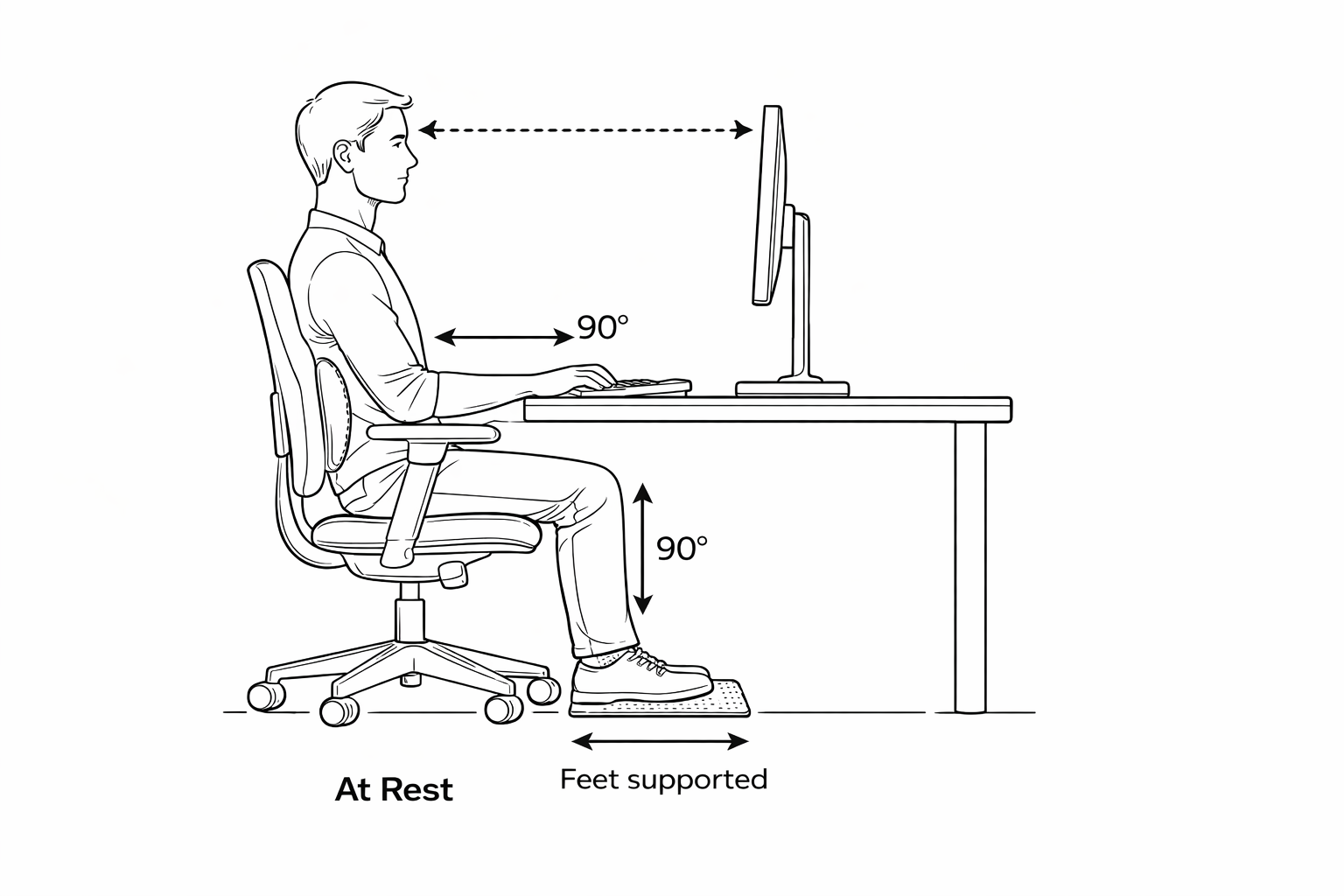 Desk setup
Does that solve everything? No. Remaining in any posture for extended periods increases susceptibility to injury, sitting included. Movement breaks are just as important, if not more important, than your ergonomic setup [1]. So:
- Sort out your ergonomics as best you can by adjusting your current setup.
- Get a timer and set it for 30-40 minutes. Use your phone, a kitchen timer, or a full-screen pop-up app (I like "Flow") so it's impossible to miss.
- Stand up and move a little each time the interval ends. Repeat.
- Look into cost-effective upgrades. Ask your employer about spare chairs, desks, risers, or footrests.
A note on sit-stand desks: many people think they should replace sitting with standing. Don't. A clinical protocol used to provoke back pain is simply standing (relatively still) for two hours [2]. If you have a sit-stand desk, use it to switch between sitting and standing every 30-60 minutes.
If you're on your feet all day
Sustained spinal compression and muscular fatigue increase injury risk, and pain creeps in from extended loading. A few things that help:
- Shift your feet often and think "soft knees". Shifting your weight gives your spinal joints loading variety
- Raise and rest one foot at a time on a low surface. This reduces pain development in people with low back pain [3]
- Anti-fatigue mats, if your workplace allows
- Take sitting breaks when you can, to interrupt the sustained posture
Neck and upper back
While not the focus here, a few quick tips:
- Bring screens to eye level when possible: hold your phone higher, put your monitor on a riser
- Avoid a forward-head position; it increases load on the cervical spine and is linked to neck pain [4]. Catch yourself slouching and perform chin tucks (described in the exercise library) to train weakened neck flexors.
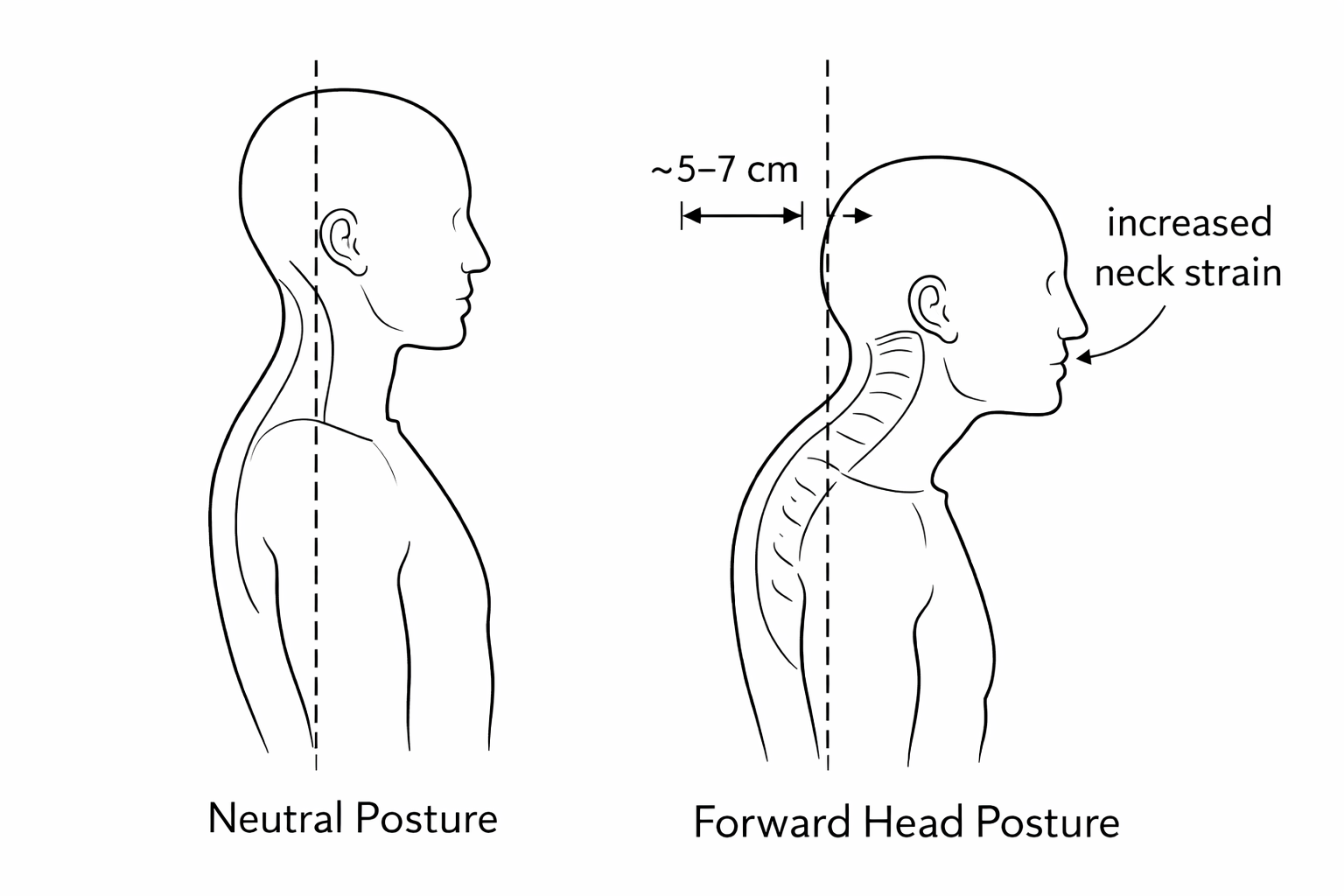 Forward head posture
References
- [1] Sonne et al. (2011). https://doi.org/10.1016/j.apergo.2011.03.008
- [2] Nelson-Wong & Callaghan (2010). https://doi.org/10.1080/00140139.2010.500400
- [3] Fewster et al. (2019). https://doi.org/10.1016/j.humov.2019.03.013
- [4] Douglas & Gallagher (2018). https://doi.org/10.1016/j.apergo.2018.02.020