Lesson 03 · 7 min read
Mindset, Fear, and the Pain Cycle
I won't tell you to buy crystals and start praying to the lumbar spine god, but I will be honest: your mindset matters.
Your mind and body are neighbours
Your body and mind are neighbours, and they borrow from each other often. A study of over 500,000 adults in Sweden [1] found that:
- Pain and mental illness influence each other simultaneously: "pain causes depression and depression causes pain"
- People with pain are twice as likely to develop anxiety or depression, and people with anxiety or depression are twice as likely to develop pain
Your mind and body share the same nervous system and the same biology. To say that pain is "purely physical" or "all in your head" would both be incorrect. The shared nervous system shapes the experiences of both. Understanding this shifts us from helplessness to a practical place, where positive thoughts and beliefs help calm the nervous system.
Beliefs predict recovery
So-called "yellow flags" (essentially how people feel about their pain) are highly predictive of pain outcomes [2,3]. Some yellow flags include:
- Illness beliefs
- Fear of movement
- Low confidence
- Catastrophizing
Self-efficacy and depression levels are strong predictors of rehab outcomes [3]. So why don't we all just sit around and believe things will get better while taking no action? It doesn't quite work like that. Our beliefs influence our biology, but so do our movements and daily habits. A person who believes they can't get better is more likely to engage in destructive behaviours and less likely to commit to a structured recovery plan.
Fear avoidance
Here's where we get specific to back pain. Some people avoid movement because they interpret pain as dangerous. Avoiding movement is a one-way ticket to further disability.
Painful movement → fear of movement → decreased movement → lost strength & confidence → decreased capability → pain
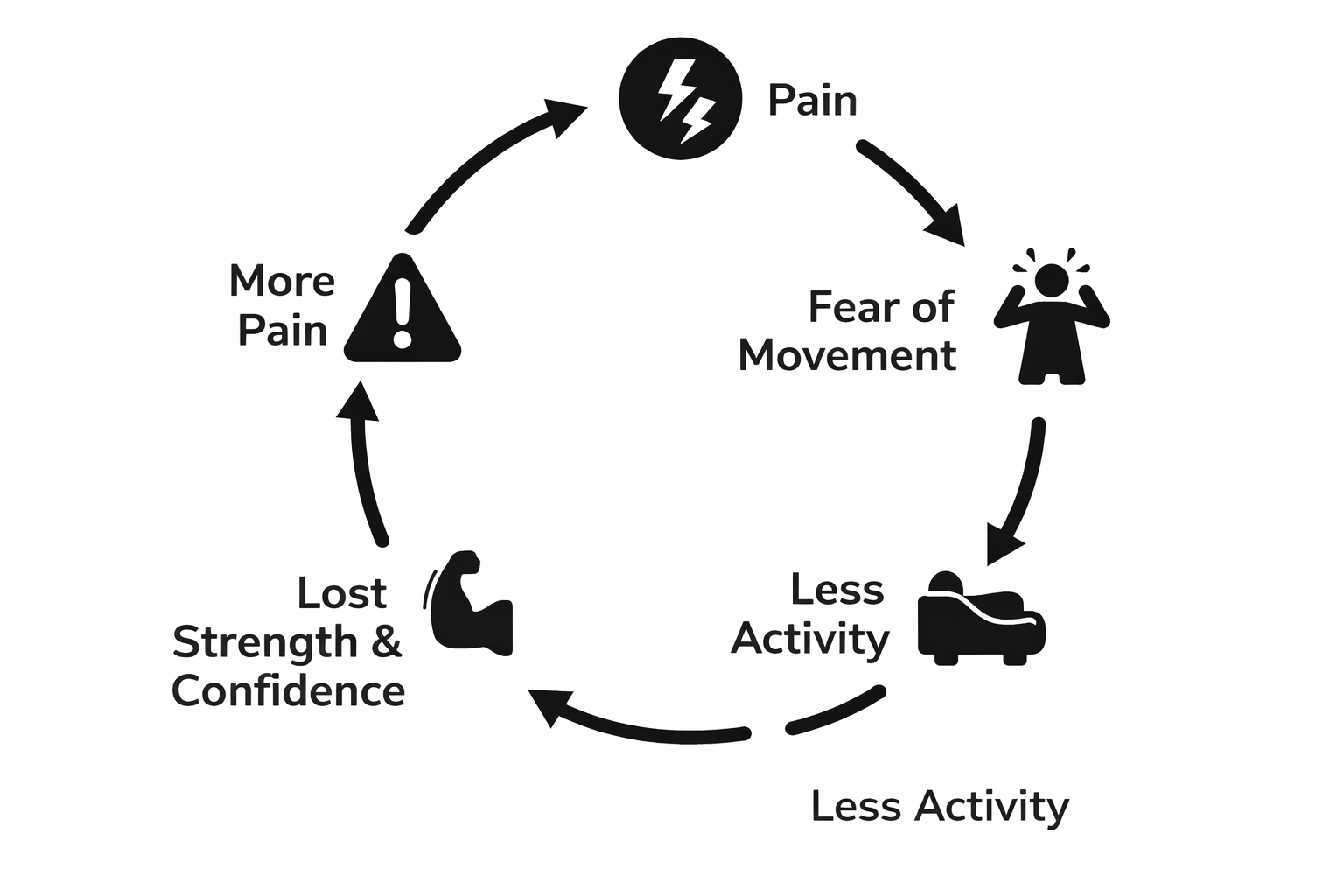 The fear-avoidance cycle
This is a self-fulfilling process where pain begets greater disability and pain if the cycle isn't broken [4]. One study tracked a group's fear-avoidance levels for a year [5] and found that people with higher fear avoidance were twice as likely to experience an episode of low back pain.
Pain catastrophizing
We all know someone who thinks the sky is falling every time a minor inconvenience pops up. In relation to pain, catastrophizing thoughts sound like:
- "This is terrible and getting worse."
- "I can't stop thinking about my pain."
- "Nothing will help."
A review found that catastrophizing predicted worse pain intensity and disability [6]. The good news: reductions in catastrophizing were associated with better pain outcomes.
So what helps?
- Don't catastrophize. Become aware of negativity toward your pain and label it: "I'm thinking negative thoughts about my pain." That breaks the loop. Don't indulge it (ranting, Googling "will my pain ever get better?", skipping your walk because your back is a little sore).
- Stay active. Action is the antidote to anxiety. Keep moving.
- Build confidence. Give yourself a stack of undeniable proof that you can manage back pain and keep moving. Let the small wins add up by showing up and sticking to the plan.
- Have realistic expectations. People who expect to recover tend to recover more [7]. You don't have to become a beacon of toxic positivity. Just remind yourself that things can get better, and don't assume the worst.
References
- [1] Bondesson et al. (2018). https://doi.org/10.1002/ejp.1218
- [2] Glattacker et al. (2013). https://doi.org/10.2340/16501977-1104
- [3] Glattacker et al. (2018). https://doi.org/10.1037/rep0000200
- [4] Leeuw et al. (2007). https://doi.org/10.1007/s10865-006-9085-0
- [5] Linton et al. (2000). https://doi.org/10.1080/08870440008407366
- [6] Wertli et al. (2014). https://doi.org/10.1097/BRS.0000000000000110
- [7] Cancelliere et al. (2016). https://pubmed.ncbi.nlm.nih.gov/27610218/