Lesson 02 · 5 min read
Walking and Unloading Your Spine
Yes, you read that right: walking is so important that it gets its own section, with a couple of other goodies too. Research recommends walking as the baseline activity for people with back pain [1].
Why walking?
Walking is particularly useful when dealing with back pain and flare-ups because:
- Walking is how we get around, and that's worth protecting
- It's low impact
- It's easily scalable: short walks, long walks, fast walks, slow walks
- It requires no equipment
- It keeps us mobile
- It relieves back pain for some
There's also a biomechanical basis for recommending walking. Walking provides:
- Low-rate rhythmic forces that load and unload the spine
- This loading pattern enhances nutrient transport to our intervertebral discs [2]
- A free arm swing that "dampens" the rotational forces on your trunk and head [3]
- Patients with disc herniations tend to stiffen their posture while walking and stop swinging their arms freely, which may unintentionally cause greater rotational forces on the spine [4]
How to walk with back pain
I bet you never thought you'd be told how to walk again. Well, you bet wrong.
- Let your arms swing naturally, which reduces the rotational forces on your spine
- Think about being stable, not rigid
- Start with short bouts of walking, continuing until discomfort, then unload / decompress
- Build up distance and speed over time
The pattern is simple: walk a comfortable distance, decompress for a few minutes (as needed), and walk again when symptoms settle. Repeat.
Unloading / decompression techniques
Counter-top decompression
- Stand facing a sturdy bench, table, or countertop that is around hip height.
- Place your hands or forearms on the surface, then offload your weight onto it. It helps to turn your palms forward and not let your shoulders shrug.
- Let your knees soften slightly and allow your arms to support some of your bodyweight. If the surface is stable, you may fully offload your weight onto it.
- Breathe slowly and feel your low back gently unload. Hold for 30-60 seconds, or however long feels comfortable, then slowly walk your feet back in and stand up tall.
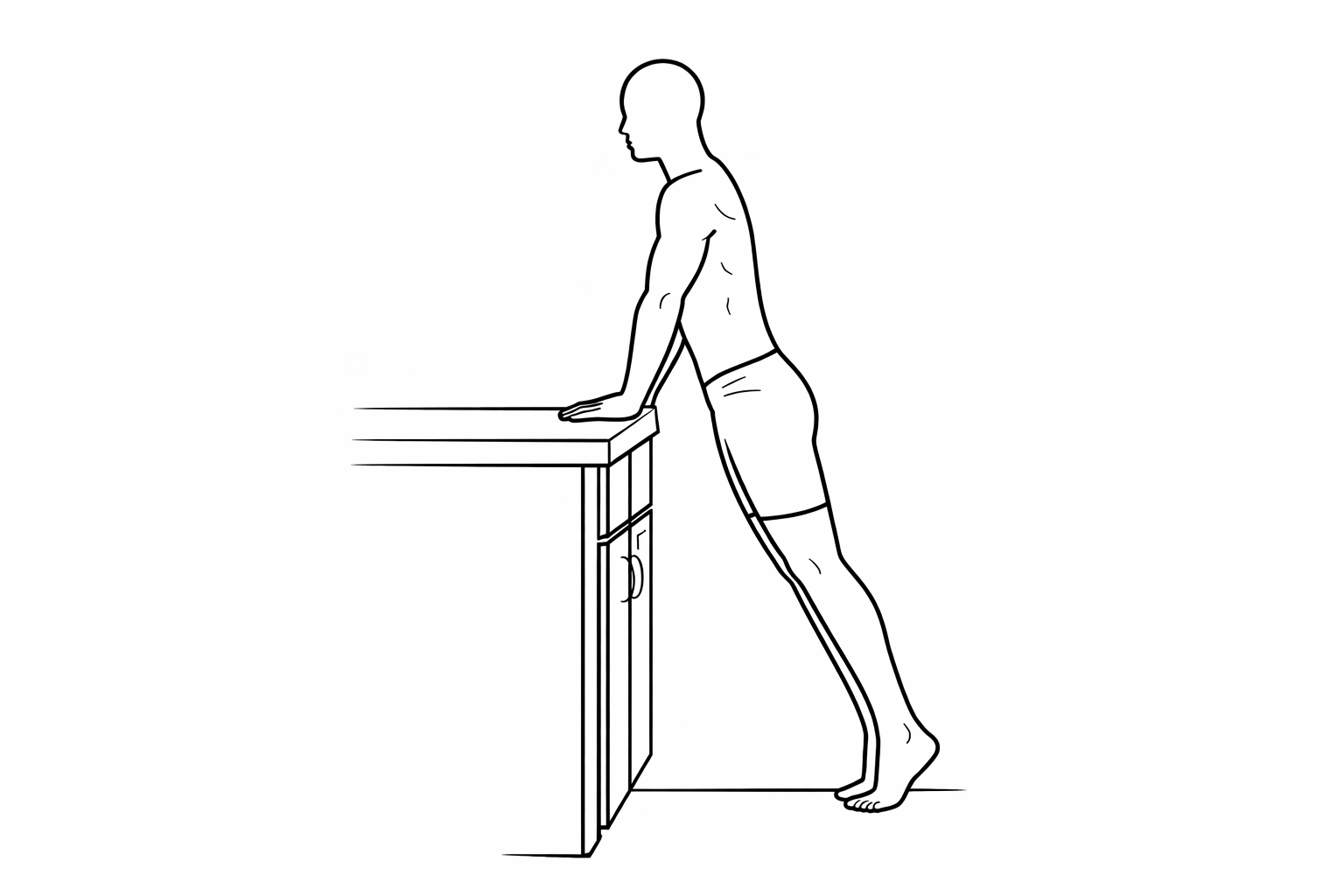 Counter-top decompression
Lying with legs up (90/90 position)
- Lie on your back and rest your lower legs on a chair or couch.
- Form a 90-degree angle at your hips and knees.
- Rest and remain still for a few minutes.
- Repeat as needed.
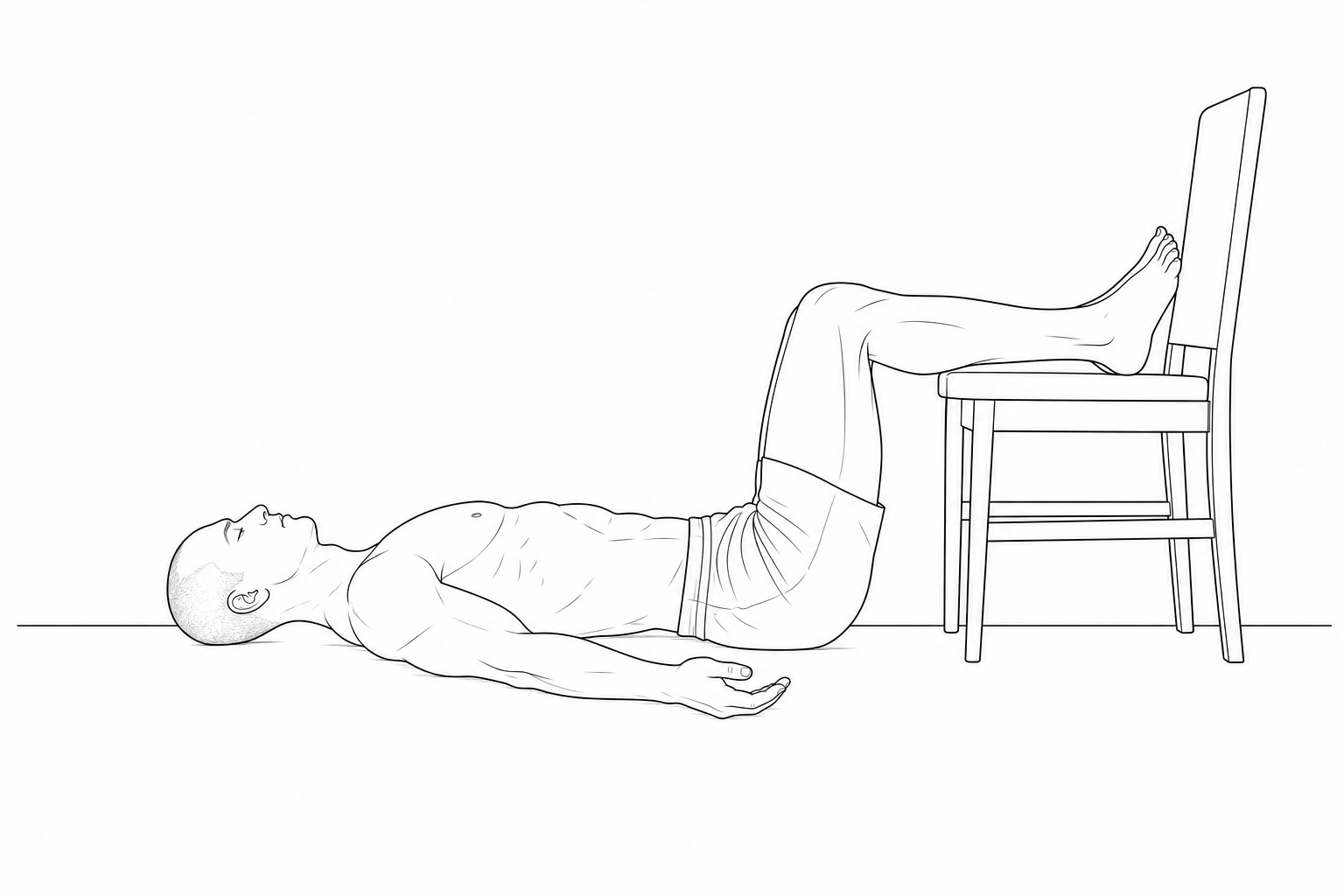 Legs-up 90/90 decompression
This position unloads the posterior elements of the spine in a safe, stable way, but it is less accessible and portable than the counter-top decompression.
References
- [1] Vanti et al. (2019). https://doi.org/10.1080/09638288.2017.1410730
- [2] Gullbrand et al. (2015). https://doi.org/10.1097/BRS.0000000000001012
- [3] Pontzer et al. (2009). https://doi.org/10.1242/jeb.024927
- [4] Huang et al. (2011). https://doi.org/10.1007/s00586-010-1639-8